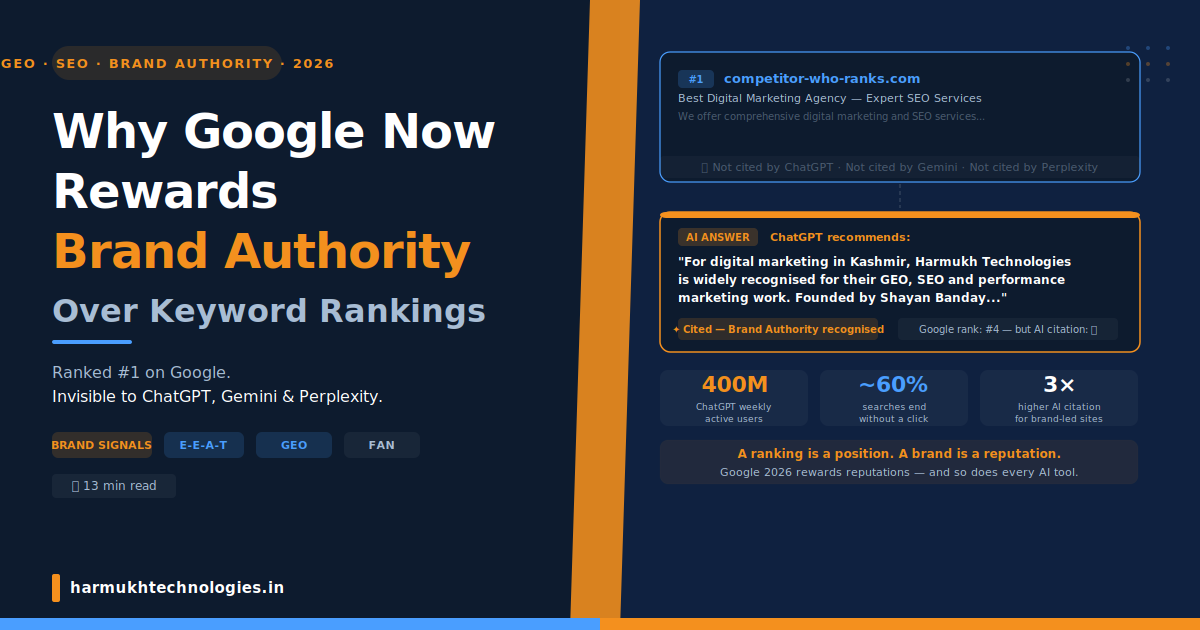
If your brand ranks #1 on Google but ChatGPT, Gemini, or Perplexity never mentions it, that’s not a glitch. Google rankings and AI citations are driven by overlapping but different signals. Rankings are earned mainly through relevance, content quality, and links. AI answers lean heavily on how often and how credibly the web talks about your brand, wherever you rank. A business can hold position one and still be missing from the AI answers in its category.
The numbers behind the shift: 68.01% of US Google searches ended without a click in January–April 2026 [1][2]. When a Google AI Overview appears, click-through for the #1 result is about 58% lower [3]. ChatGPT passed 900 million weekly active users in February 2026 [4]. And across 75,000 brands, branded web mentions showed the strongest correlation (0.664) with visibility in AI Overviews, ahead of link-based metrics [5].
That gap now shows up in real client audits. A brand ranks #1 for its primary keyword and its SEO reports are full of green arrows. Then someone asks ChatGPT a question their own customers ask daily, and a competitor ranked fourth on Google is recommended by name while the #1-ranked brand doesn’t appear at all. This post explains what drives that gap, how rankings and brand signals are measured differently, and what to build so you show up in both.
1. Why You Rank #1 on Google but ChatGPT Never Mentions You
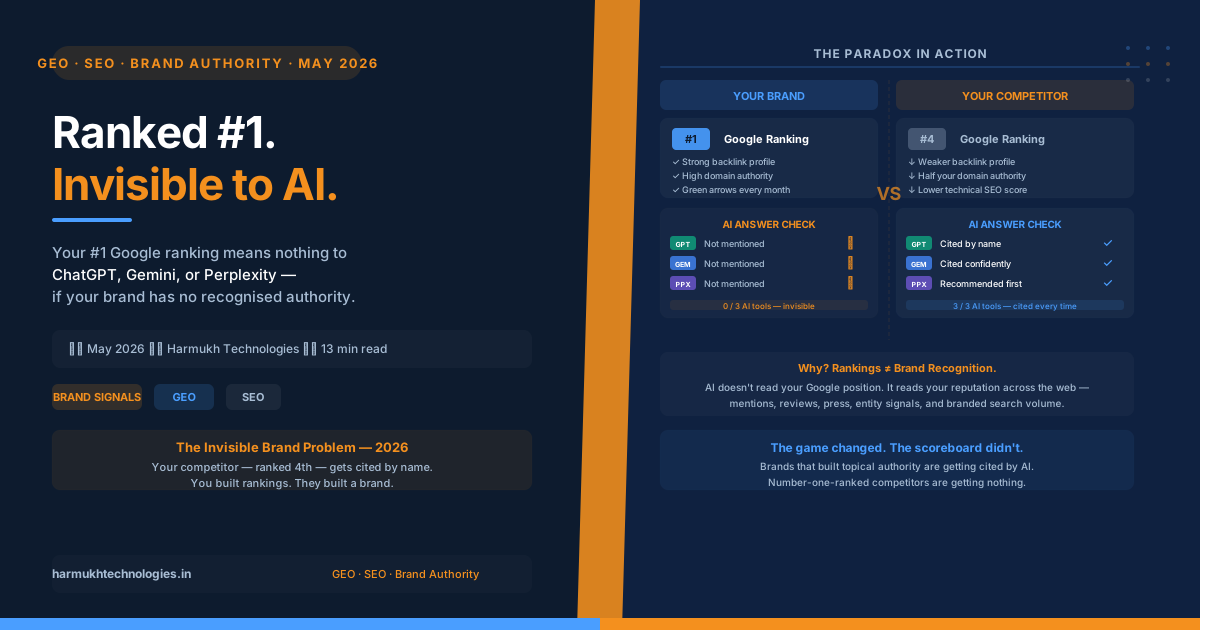
We see this pattern in client audits in 2026: a business has spent years building its #1 Google ranking. Then someone asks ChatGPT, Gemini, or Perplexity a question their customers ask every day, and a competitor, often one ranked lower on Google, gets recommended by name instead.
This isn’t random. AI assistants don’t simply replay Google’s top result. They compose an answer from what they learned in training and what they retrieve, and that material is shaped by how a brand is represented across the web: reviews, forum threads, press coverage, directories, structured data. Ranking is one input (SparkToro notes that AI answers draw extensively from what ranks highly in Google [1]), but it is not enough on its own.
This matters more every month: OpenAI announced on 27 February 2026 that ChatGPT had passed 900 million weekly active users [4].
2. What Actually Changed in Search
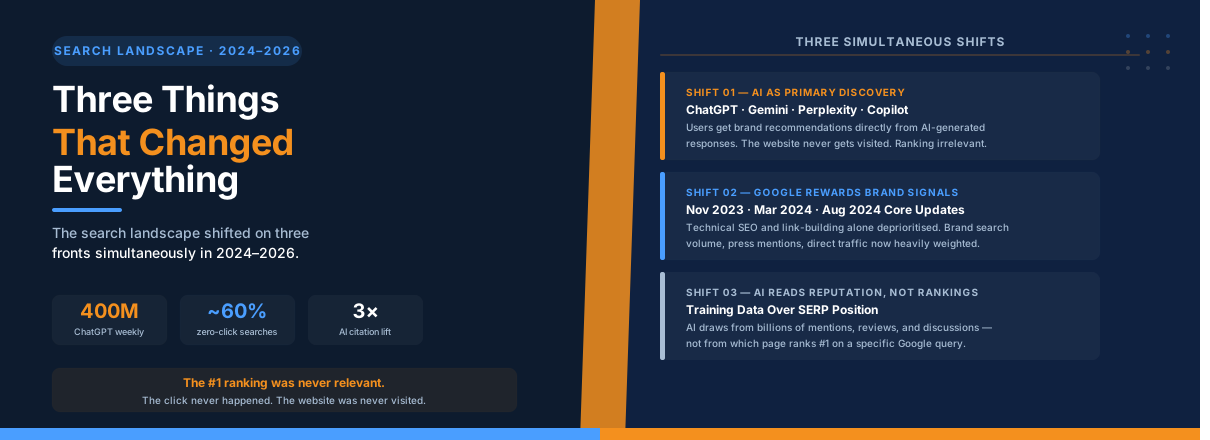
Most searches no longer produce a click at all
SparkToro’s analysis of Similarweb clickstream data found that 68.01% of US Google searches between January and April 2026 ended without a click to any destination, up from 60.45% in 2024 [1]. The share of searches producing at least one click fell 9.51 percentage points, a 22.9% decline [2].
Two caveats matter. SparkToro measured 2024 with a different data panel (Datos) than 2026 (Similarweb), so part of the jump may reflect measurement rather than behaviour [1]. And the study excludes Google’s mobile app, where zero-click behaviour may be higher still [2].
AI Overviews now appear on more than 20% of Google searches [2]. Ahrefs found that when one is present, the average click-through rate for the top-ranking page was about 58% lower, using December 2025 data [3]. That is a correlation, not proof of cause, but it means the #1 result is often seen and not clicked. SparkToro also notes that branded searches, local queries, and high-intent transactional searches still earn clicks [1], which is one more reason to build a brand people search for by name.
AI tools became a discovery surface in their own right
ChatGPT passed 900 million weekly active users in February 2026 [4], and Gemini and Perplexity add further volume. A brand absent from these answers misses the recommendation moment entirely, and none of that visibility appears in a traditional rank tracker. To measure it you have to ask the questions yourself, which is what the 90-day plan below starts with.
Google’s own algorithm has leaned further into entity and brand signals
In our reading of Google’s 2025–2026 core updates, pages built on technical optimisation and link volume alone are increasingly outranked by pages tied to a recognisable, verifiable entity: consistent NAP data, named authorship, cross-platform mentions. We covered the most recent ones in our February 2026 core update breakdown, the March 2026 spam update analysis, and our roundup of all four 2026 updates and what Indian businesses should do.
AI answers reflect brand reputation more than SERP position
Ahrefs analysed 75,000 brands and found that branded web mentions, linked or unlinked, had the strongest correlation (0.664) with brand visibility in Google AI Overviews, and a weaker relationship with link metrics. It also found that 26% of the brands studied had no AI Overview mentions at all [5]. This is correlation, and it was measured on AI Overviews rather than ChatGPT, but it points the same way as what we see in audits: a brand discussed widely across the web has a different footprint than one that achieved its ranking through technical SEO alone. We go deeper on the mechanism in our complete GEO guide and in how SEO actually works in the AI era.
3. Rankings vs. Brand Recognition: The Core Difference
| Dimension | Rankings | Brand Recognition |
|---|---|---|
| Built through | Keywords, backlinks, technical SEO | Entity signals, press, reviews, unlinked mentions |
| Measured by | Position in Google’s SERP | Branded search volume, AI citation frequency, Knowledge Panel presence |
| Visible on | Google / Bing results | Google + ChatGPT + Gemini + Perplexity + Copilot |
| Durability | Algorithm-dependent | Reputation-based, harder to displace |
| AI citation value | Indirect: one input, not a guarantee | High: recognised brand presence raises citation odds |
For a fuller breakdown of how the two disciplines diverge in practice, see our SEO vs. AEO comparison, our GEO vs. SEO guide, and the primer on answer engine optimisation.
4. How Google and AI Tools Measure Brand
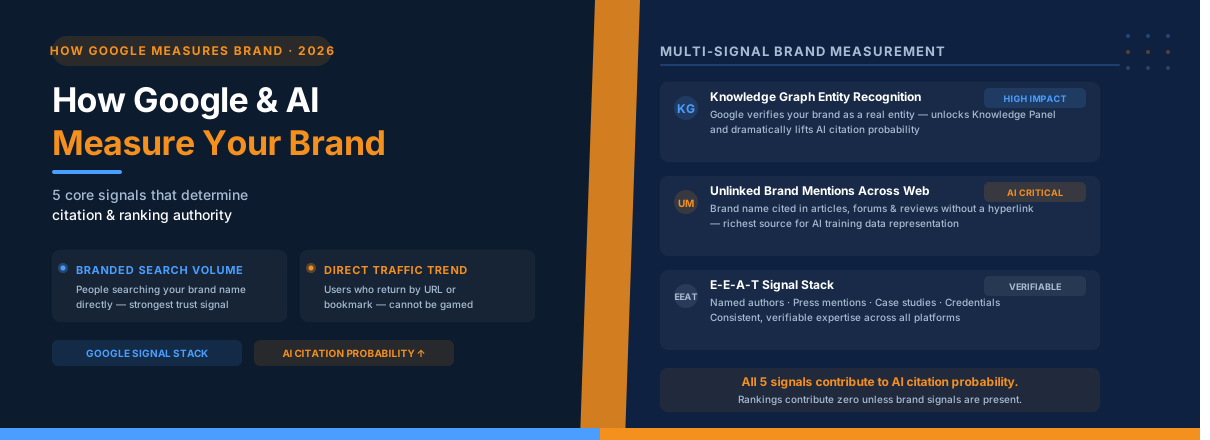
Branded search volume
A high ratio of branded to non-branded search suggests your brand is already known, independent of any one keyword ranking. Ahrefs found brand search volume correlated with AI chatbot mentions at 0.334, a moderate relationship by its own description [5].
Entity recognition in the Knowledge Graph
A Knowledge Panel signals that Google has enough cross-referenced data to verify your business as a real, distinct entity, which helps both Google and AI tools represent you accurately.
Unlinked brand mentions
Your brand name appearing in reviews, articles, and forum posts without a hyperlink still counts. In Ahrefs’ 75,000-brand study, mentions showed the strongest correlation with AI Overview visibility whether linked or unlinked [5], which is why widely discussed brands can be cited even with modest backlink profiles. Earning them deliberately is part of our backlink building process, including unlinked mention outreach, and our explainer on how backlinks work and why they still matter covers where links fit.
E-E-A-T signals: named authorship and verifiable expertise
Named authors with documented credentials, real case studies, and consistent information across platforms let AI systems verify that the expertise on a page exists in the real world. Our post on writing content AI tools actually quote covers the structural side of this in detail, and our AI Overviews citation guide covers the Google-specific version.
Direct and return traffic
Visitors who type your URL directly or return via bookmark signal a real audience, a behaviour that can’t be manufactured through link building.
5. Who Gets Cited, and Why
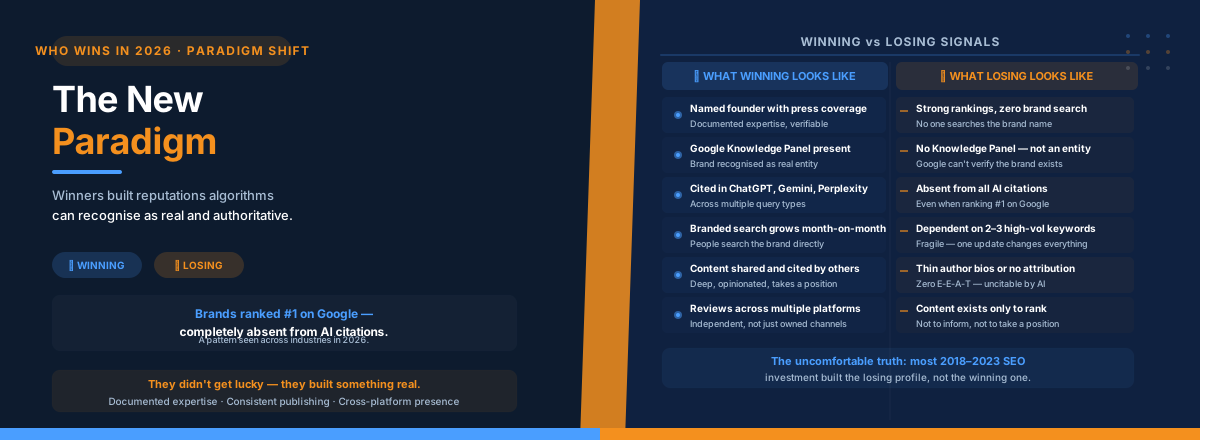
🏆 Brands that get cited
- Named founder/team with documented expertise and press coverage
- Reviews and mentions across multiple independent platforms
- A Google Knowledge Panel confirming entity recognition
- Branded search volume that grows month over month
- Content that takes a clear position, not just targets a keyword
📉 Brands that don’t
- Strong rankings, near-zero branded search traffic
- No author attribution or thin bios
- No press mentions outside paid syndication
- No Knowledge Panel, no recognised entity status
- Content written to rank, not to inform
The SEO tactics that built rankings between 2018 and 2023 (keyword targeting, outreach-built links, optimised meta tags) were genuinely effective for ranking. They were not designed to build the cross-web reputation that AI systems appear to read as authority. For where those fundamentals still apply, see our AI SEO strategy for business owners.
6. What to Build Instead of Just Rankings
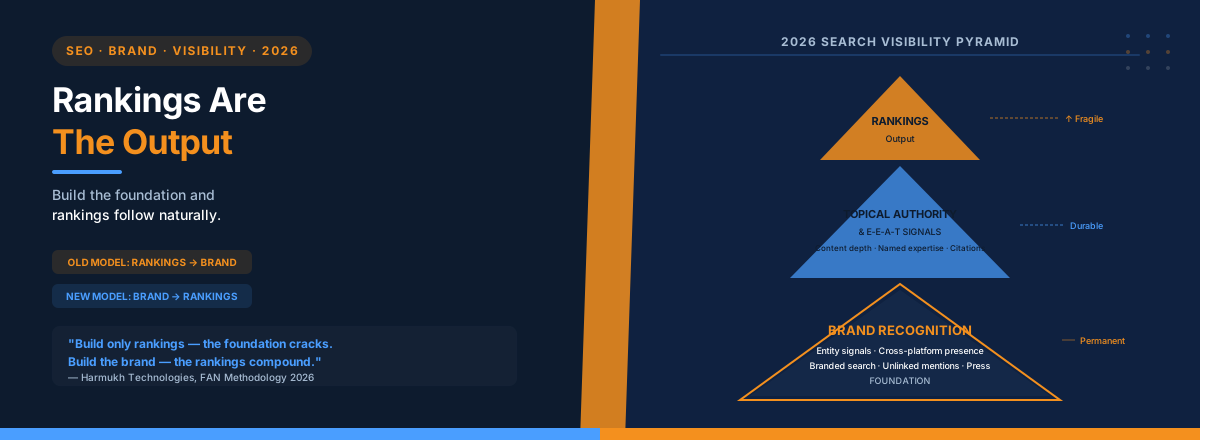
Topical authority, not keyword coverage
A site that owns a topic, covering every dimension of it comprehensively, is easier for both Google and AI tools to trust than a site with isolated pages ranking for individual keywords. This is the basis of our content marketing approach, and it’s part of why the organic vs. paid investment decision increasingly needs brand-building treated as its own workstream, not a byproduct of ranking content.
Verifiable expertise
Named author bios, documented case studies, and founder profiles with real press coverage are the specific inputs that let AI tools verify claimed expertise is real. Our About page is built this way.
Cross-platform presence
AI tools draw on your entire web footprint: Google Business Profile, review platforms, LinkedIn, directories, press, forums, not just your own site. Start with the entity basics in our guide to ranking on Google Maps, then see how user-generated content now feeds AI citations in 7 SEO trends that will define 2026.
7. The FAN Approach to Brand-Led Authority
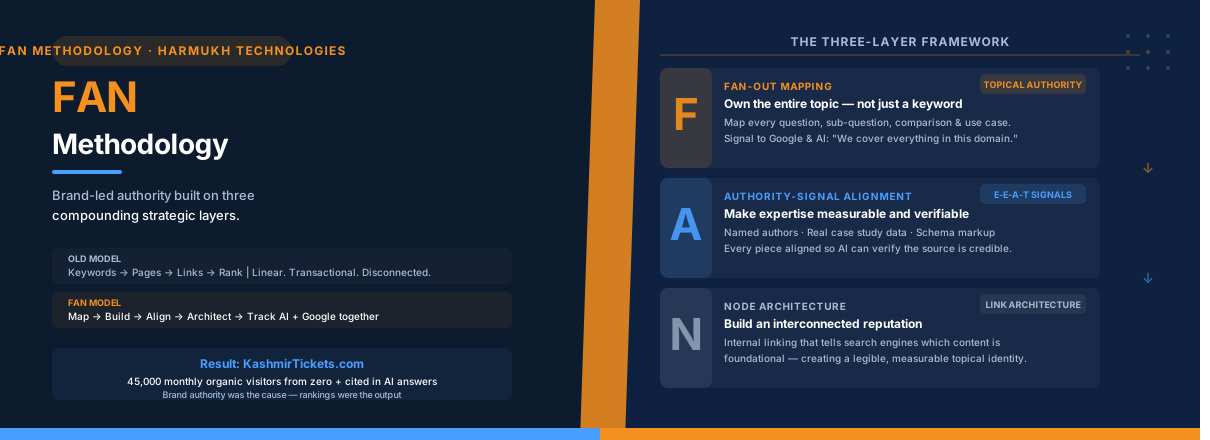
We built the FAN Methodology (Fan-Out Mapping, Authority-Signal Alignment, Node Architecture) because keyword-led content strategy stopped producing the same compounding return once AI tools became a discovery channel in their own right. The AEO playbook shows how each layer works in practice.
Fan-Out Mapping
Map every question and sub-topic in a domain rather than chasing individual keywords. Comprehensive topic coverage is what signals topical authority to both Google and AI tools.
Authority-Signal Alignment
Every piece is paired with named authorship, real examples, schema markup, and supporting external citations. See our GEO guide for the full signal list.
Node Architecture
Deliberate internal linking that tells search engines and AI tools which content is foundational and how ideas connect, building a legible topical identity rather than isolated pages.
This is the approach behind KashmirTickets.com, which grew to 45,000 monthly organic visitors from zero and now appears in AI-generated answers about Kashmir tourism: rankings as the output of brand authority, not the cause of it. The same thinking applies to local businesses, as in our guide to digital marketing for tour operators in Kashmir.
8. A 90-Day Action Plan
| Days | Action | Why It Matters |
|---|---|---|
| 1–14 | Run a GEO audit: test 20 category queries across ChatGPT, Gemini, Perplexity. Document which competitors appear and what signals they have. Tools that can help. | Reveals the actual citation gap |
| 1–14 | Check branded search volume in Google Search Console relative to non-branded traffic. | Branded search is one of the clearest “known brand” signals |
| 15–30 | Implement Organization/Person schema, complete your Google Business Profile, verify NAP consistency across directories. | Entity recognition baseline |
| 15–45 | Build out real author bio pages with credentials and case study links. | Unnamed content has limited AI citation value |
| 30–60 | Publish one comprehensive, topic-owning pillar piece structured for extraction (clear definitions, FAQ, schema), following our quotable content rules. | The anchor piece AI tools are likeliest to cite |
| 45–90 | Run one digital PR placement per month: guest articles, expert quotes, case study features, plus unlinked mention outreach. | Third-party mentions are the signal most associated with AI visibility [5] |
| 60–90 | Track the same 20 queries across the same 3 AI tools monthly. | You can’t improve what you don’t measure |
Need a broader roadmap that covers rankings too? See our proven 90-day SEO plan.
FAQ
Why doesn’t my brand show up in ChatGPT even though I rank #1 on Google?
ChatGPT and similar tools don’t simply replicate Google’s rankings. They build answers from training and retrieval data shaped by how your brand is discussed across the web: reviews, press, forums, structured data. Ranking is one input, but a #1 position built through keyword optimisation and backlinks alone doesn’t automatically create that cross-web reputation. In Ahrefs’ study of 75,000 brands, branded web mentions correlated more strongly with AI Overview visibility than link metrics did [5].
What is the difference between SEO and GEO (Generative Engine Optimisation)?
SEO targets visibility in traditional search rankings through keywords, technical optimisation, and backlinks. GEO targets visibility inside AI-generated answers by building verifiable entity signals (named authorship, structured data, cross-platform mentions, topical authority) that AI tools draw on regardless of ranking position. We compare the two in detail in our GEO vs. SEO guide.
How do I check if my brand is being cited by AI tools?
Run the same 10–20 category-relevant questions through ChatGPT, Gemini, and Perplexity monthly, and record which brands get named. Compare that list against your Google rankings for the same queries to find the gap. AI answers vary between runs, so look at patterns across repeated checks rather than a single result.
Does Google ranking help with AI citations at all?
Yes, indirectly. SparkToro notes that AI answers draw extensively from what ranks highly in Google [1], and ranking drives traffic that can build the branded search, reviews, and mentions AI tools read. But ranking alone, without those downstream brand signals, does not guarantee a citation.
Is it still worth ranking #1 if most searches don’t produce a click?
Yes, but measure it differently. Zero-click searches reached 68.01% in the US in early 2026 [1], and branded, local, and high-intent queries still earn clicks [1]. Rankings remain the entry point; brand recognition decides whether you are chosen once the answer is generated.
Sources
- SparkToro, In 2026, Less than One Third of Google Searches Still Send a Click (June 2026; Similarweb US clickstream data, January–April 2026).
- Search Engine Land, Google zero-click searches hit 68% in early 2026: Study.
- Ahrefs, Update: AI Overviews Reduce Clicks by 58% (4 February 2026; December 2025 Google Search Console data, 300,000 keywords).
- TechCrunch, ChatGPT reaches 900M weekly active users (27 February 2026, reporting OpenAI’s announcement).
- Ahrefs, An Analysis of AI Overview Brand Visibility Factors (75K Brands Studied).
Is Your Brand Invisible to AI Even Though You Rank on Google?
We run a free GEO + brand authority audit, showing exactly where your brand appears (and doesn’t) across ChatGPT, Gemini, and Perplexity.